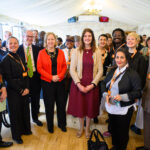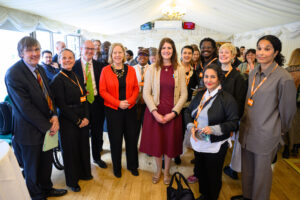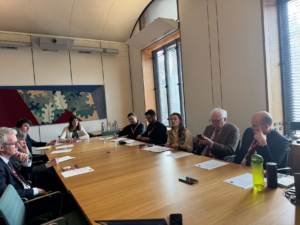

APPG members and supporters pictured in Parliament.
(L-R: Julie Lomax, CEO at a-n The Artists Information Company, The Earl of Clancarty, Gemma Dean. Gemma Dean, Head of Development at Creative Land Trust, Jon Wakeman, Co-Founder, East St Arts, Piarvé Wetshi, Marketing and Communications Executive at Creative Land Trust, Lord Freyberg, Kate Rosser Frost, Head of Communications & Engagement, DACS, Ben McCloskey, Parliamentary Assistant for Cat Eccles MP, Paula Orrell, Director, CVAN England)
The All-Party Parliamentary Group for Visual Arts & Artists held a meeting on Wednesday 9 July to discuss affordable studio space in the UK.
Chaired by The Earl of Clancarty, members were joined by Gemma Dean of Creative Land Trust and John Wakeman, Co-Founder of East Street Arts, for a discussion on securing affordable, long-term creative workspaces.
Gemma Dean outlined Creative Land Trust’s model for tackling the rapid loss of affordable studios across London. She highlighted the role of creative workspaces as R&D hubs for the wider creative economy, research showing a 4.4% uplift in nearby land values, and the Trust’s use of long leases and virtual freeholds to lock in affordability – securing three properties since 2020. The discussion touched on high studio demand despite wider vacancy rates, potential planning system improvements, and the value of making creative hubs more visible to support arts education and career pathways. Members asked about current DCMS policies around affordable workspaces and asked whether existing current funding is sufficient. Members discussed whether the UK could offer a studio support model akin to grassroots music venues and spoke about specific challenges of rural provision, including empty shops offset by high rents; Creative Land Trust pointed to productive collaborations with developers and local authorities, underpinned by planning obligations for affordable workspace.
John Wakeman shared East Street Arts’ journey from £600 in a 2,000 sq ft Leeds mill in 1993 to managing around 60–70 temporary spaces nationwide, describing how artists often help regenerate neighbourhoods only to be priced out, and emphasised three ingredients for success: supportive local government, available property, and entrepreneurial artist groups. Case studies presented included a 250-year lease in Keighley and the Barnsley model. Recommendations focused on funding early-stage development and feasibility, investing in infrastructure and networks, measuring impact by legacy rather than short-term outputs, and ring-fencing grassroots visual arts and makerspace investment.
APPG members in attendance were:
The Earl of Clancarty (Crossbench Peer)
Dr Simon Opher MP (Labour, Stroud)
Manuela Perteghella MP (Liberal Democrat, Stratford-upon-Avon)
Lord Freyberg (Crossbench Peer)